Matter over Thread in Rust?
Jan
- 5 minutes read - 1032 wordsYes.
In 2024, I decided to build my own Matter devices to extend my smart home with functionality that I could not get from hardware vendors. I was annoyed by the slow adoption of what I thought was the better smart home standard. It was meant to get support from official systems like Google Home and Apple Home, unlike many of the hobbyist or old-school systems based on Zigbee or KNX.
I had absolutely no idea where I should start, but I found the Matter Arduino library from SiliconLabs and thought Arduino is a great start! I bought the MGM240P and some sensors for it and got started. Thanks to an amazing friend of mine I was able to get something working within a few days and thought this is easy! I can do this! There was just one caveat: I spent roughly 30 Euros on the device and wanted to make more of these, and for that it had to be cheaper. The dev board I bought was just not going to work.
After a bit of research I stumbled across a fairly new library at the time to bring Matter support to embedded Rust. I had already a few years under my belt with Rust and I felt way more comfortable with it than with Arduino or large C++ SDKs like the official matter-library. With some amazing support from the community (mostly ivmarkov’s embassy project) I made progress. Slowly but steadily he helped me bring my project alive, and improve the library while we’re at it. We debugged issues with ESP32-H2 together, introduced better Sleepy End-Device support and in the end made my original goal a reality.
I now have a battery powered soil moisture sensor in my office which cost ~9 Euros per piece. The device should last between 1–2 years on a single AA cell and provide a reading every 6 hours.
The project is very similar to automatous-io/xiao-soil-moisture-sensor-matter-thread, I took the calibration and voltage reading code from the project as a starting point. I think we both discovered around the same time that the XIAO Soil Moisture Sensor is a great device to port to Matter due to the Thread-supporting MCU on the board.
The Overview
Device: Seeed XIAO Soil Moisture Sensor kit — a capacitive soil probe, three status LEDs, a button and an AA battery holder on a XIAO ESP32-C6 carrier (4 MB flash, external U.FL antenna). ~9 EUR per piece.
MCU: ESP32-C6 (32-bit RISC-V, runs at esp-hal’s default 80 MHz preset) with an integrated 802.15.4 radio used for both Thread and BLE.
Sensors / inputs:
- Capacitive soil moisture probe, read via ADC on GPIO1 with excitation PWM on GPIO21
- Battery voltage via ADC on GPIO0 (single AA cell behind a TPS61021A boost converter to 3V3)
- User button on GPIO2 (active low)
- Three status LEDs on GPIO18/19/20 (yellow/green/red)
Crucial Libraries:
- rs-matter
- rs-matter-embassy
- esp-hal
- esp-radio (802.15.4 Thread + BLE support)
What I learned
Matter basics: commissioning via BLE. The device joins the fabric over BLE while Thread comes up in parallel, and from then on everything rides on Thread/IPv6. Because I use the test credentials (VID
0xFFF1, PID0x8010), every ecosystem shows an “uncertified device” warning — expected, just ignore it. Fabrics are persisted in flash (sequential-storage), so even a deep-sleep boot comes back as the same commissioned device.Thread basics: the issues we hit and how we debugged them. First the ESP32-H2, together with ivmarkov (#13); then on the C6: BLE advertisements never went on air in concurrent commissioning mode (#82). Turned out BLE and Thread share the radio, and BLE has to be powered down properly in between — that needed power-domain work in esp-radio/esp-hal (esp-hal#6406). SED support needed OpenThread patches on top (openthread#121, #122). We debugged with defmt logs over USB plus a sniffer. The logs in #84 show the Check-In being sent before Thread and the SRP lookup were even up — which is exactly why it behaved so racy in Home Assistant.
Protocol: SED, SIT vs LIT. A Sleepy End Device basically tells its parent “I’m asleep, buffer my stuff” and polls for it. SIT (idle ≤ 15 s) is for things that should react fast; LIT (idle of minutes) is for sensors like this one, where the controller subscribes to Check-Ins. But LIT only really deep-sleeps if the controller plays along (Google/Apple didn’t support it yet, Samsung was beta-only, Home Assistant had a bug), otherwise the device silently falls back to SIT and burns battery.
MCU: deep sleep vs light sleep. On the C6, deep sleep is a full reboot — only a timer stays powered, so everything has to live in flash. Measured ~0.12 mA at the cell on this board (the chip alone is ~7 µA; the boost converter probably eats the rest). Light sleep keeps RAM but costs 35–180 µA, which is simply the wrong tool for a LIT device. And while awake the board pulls ~100 mA at the cell, so every millisecond of awake time is worth ~25x a millisecond of sleep.
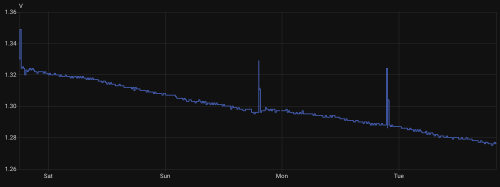
And here’s what that actually looks like on a real cell: this is the voltage of a single AA over several days at 900 s sleep cycles with a 5 s active poll (you can see the day/night cycles; the spikes are me flashing over USB-C):
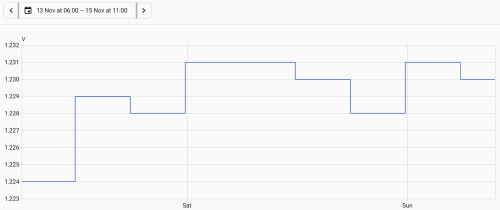
Once it settled on the 6 h LIT interval, the reported voltage in Home Assistant looked like this: flat steps, barely any movement per day, which is where the >1 year estimate comes from:
What’s next
At some point I would like to add OTA updates, but I am not sure if I will actually push that. It will require some more grease around having enough storage and things. And right now it is good enough, and I am happy I got it into a working state.
Watch where the ecosystem is heading, and see if all major platforms will support SED LIT devices in the coming months, so this becomes more usable on other platforms too.
Figure out a new device. I think now that most of the setup work is done, it’s a just about finding a new device category. Maybe a mmWave presence sensor?